
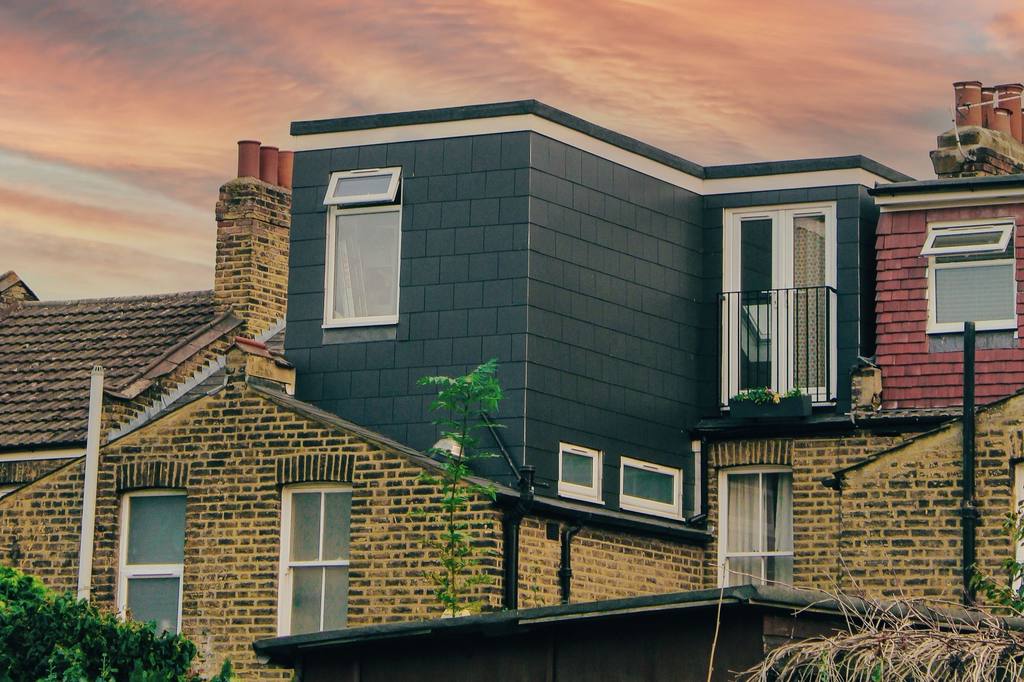
Photo by Daniel Sikpi on Pexels.
Flat roofs have an unfair reputation. Properly designed and installed, a modern flat roof on a London rear extension, back addition or box dormer can give decades of service. Badly installed - laid with too little fall, over a rotten deck, or with the insulation in the wrong place - it can start to leak within a winter or two, and the second bill is usually larger than the first. Sources were checked on 28 October 2026.
This guide is about choosing and commissioning a replacement flat roof on a house. It complements our pages on new roof costs and roof repairs in London, which cover pitched roofs and smaller repairs in more detail. Figures are indicative ranges from published sources, not quotations.
What counts as a "flat" roof
A flat roof is not truly flat. The industry standard for design, BS 6229:2025, sets a minimum finished fall of 1:80 so that water drains rather than ponds. The National Federation of Roofing Contractors' summary of the 2025 revision and manufacturer Bauder's note on the key changes both highlight that the old rule of thumb - design at 1:40 to achieve 1:80 - has gone. Instead, the design fall is derived from structural analysis or survey data, with 1:60 recognised as an appropriate starting point in many cases; Bauder notes that roofs under 50 m² may generally be designed at 1:60. Backfalls are not acceptable, and for refurbishment a level survey of the existing deck is now required.
Why should a homeowner care? Because "ponding" water is the most common thing you will see on a failing London extension roof, and a contractor who simply lays a new membrane on the old, sagging profile has not fixed the cause. Ask every roofer how they will establish and achieve the falls.
The three main coverings, with dated costs
Checkatrade's flat roof replacement cost guide (table last updated December 2024, prices excluding VAT) gives these UK averages per square metre for replacement:
- Torch-on or built-up felt: about £50-£80 per m² (average £65). Checkatrade's guides variously quote lifespans of 10-15 and 15-20 years for felt, which tells you how much depends on the product and the workmanship.
- EPDM (rubber): about £80-£100 per m² (average £90), consistent with its rubber roofing guide updated in September 2026. Lifespans of 30-50 years are quoted.
- GRP (fibreglass): about £95-£120 per m² (average £107.50). The separate fibreglass roof guide (September 2026) gives about £36 per m² for the covering alone and about £210 per m² for a fully insulated GRP roof, and says GRP lasts around 25 years, with a recoat every 10-15 years.
The same guide puts a typical whole flat-roof replacement at roughly £2,800-£7,500, and converting a flat roof to pitched at roughly £3,000-£4,500. London labour, access through a terraced house, parking suspensions and scaffold tend to push prices towards the upper end. The point to take away is not the headline per-metre rate, but the gap between "covering only" and "insulated build-up": a low quote is often a quote for a different, smaller job.
Which material suits which roof?
- Felt - modern multi-layer reinforced bitumen systems are robust and widely understood, but involve hot works or torches. Ask how the contractor manages fire risk at upstands, timber fascias and near windows.
- EPDM - a single sheet with few joints, good on simple rectangles such as a kitchen extension. Detailing at outlets, corners and rooflights is where poor installations fail.
- GRP - seamless and neat, popular on dormers and bays. Checkatrade notes that it needs dry weather for installation and that weak spots, leaks or cracking can follow if the resin is not cured correctly, so the installer's training in the specific system matters.
Whatever the covering, the deck beneath matters. Checkatrade's rubber roofing guide says it is useful to have the existing roof inspected first, because damaged or rotten decking must be dealt with before a new membrane goes on and is one of the harder costs to predict. The NFRC likewise warns that estimates for refurbishment can change once the main covering is removed. A sensible quote prices that risk in advance, for example as a rate per board or per square metre of deck.
The Part L trigger most homeowners miss
Many people assume a "like-for-like" re-cover needs no paperwork. The government's Approved Document L, Volume 1 lists "replacing the waterproof membrane on a flat roof" as renovation of a thermal element. Where more than 50% of that element's surface is renovated, paragraph 11.3 says the whole element should be improved to the Table 4.3 standard - a U-value of 0.16 W/m²K for roofs. Paragraph 4.13 allows a lesser standard where that is not technically or functionally feasible, or would not pay back within 15 years, and a footnote recognises upstand height and structural limits on flat roofs.
In practice that usually means a warm-roof build-up: insulation above the deck, under the waterproofing, with a vapour control layer beneath. It raises the roof level, so upstands, door thresholds, flashings and any rooflight kerbs have to be considered. The NFRC's advice for homeowners says that if you are refurbishing 50% or more of the roof area you should use a contractor registered with its competent person scheme or contact building control before work starts. A contractor who dismisses the question is telling you something.
Guarantees: what is actually worth having
Roofers' guarantees are only as strong as the company giving them. The NFRC says plainly that a contractor's own guarantee is worthless if the business ceases trading, and recommends an insurance-backed guarantee. NFRC CPS, which describes itself as the only roofing-specific competent person scheme in England and Wales, explains on its insurance-backed guarantee page that a 10-year IBG is issued automatically for eligible refurbishment work up to £50,000 notified through the scheme; CPS-registered contractors can also self-certify the work under the Building Regulations rather than you calling in building control.
When comparing quotes, ask for each of the following in writing:
- the contractor's own written guarantee and what it excludes;
- any manufacturer's system guarantee, and whether it requires an approved installer and inspection;
- the insurance-backed guarantee, who issues it and when you will receive the certificate;
- the building regulations compliance route - competent person scheme certificate or building control completion certificate.
Red flags that usually mean you will pay twice
- "We'll go straight over the top." Overlaying a failed roof can trap moisture and hides the condition of the deck. It may occasionally be appropriate with a manufacturer's approval and survey, but it should be explained, not assumed.
- A liquid coating sold as a "new roof". Checkatrade lists liquid coatings at about £20-£28 per m². They have legitimate uses, but a coat of paint-on product over a ponding, insulated-to-nothing roof is not a replacement, and it will not satisfy Part L.
- No mention of falls, insulation or the deck. A quote that says only "supply and lay EPDM, £X" cannot be compared fairly with one that specifies the build-up.
- Cash price, no VAT, big deposit. The NFRC warns homeowners to be careful about upfront payments and notes that cash deals without VAT are hard to trace if something goes wrong.
- Pressure to decide today. Our earlier guide on doorstep roofers and your cancellation rights explains why urgency is the cold caller's favourite tool.
How to brief and compare quotes
- Measure and photograph the roof, the edges, outlets and any rooflights, and note where water pools after rain.
- Get three written quotes - the NFRC suggests selecting up to three contractors to look at the job, ideally on recommendation, and Checkatrade likewise advises at least three.
- Ask for the full build-up: deck replacement allowance, vapour control layer, insulation type and thickness, covering, edge trims, upstands, outlets and the target U-value.
- Ask how the falls will be achieved - tapered insulation, firrings or a new deck - and what survey they will do first.
- Check the business on Companies House if it is a limited company, and confirm any NFRC, NFRC CPS or TrustMark membership on the scheme's own website rather than a logo on a van.
- Agree staged payments tied to visible progress, with a modest deposit for materials and the balance after completion and receipt of certificates.
- Plan access and protection: scaffold, skip or waste removal, protection of the house and garden, and what happens if it rains mid-job.
When the roof is part of a bigger job
New rear extensions and loft dormers are normally built under building regulations as part of the wider project, so the roof will be inspected as part of that work. The questions above still apply - particularly falls, insulation and the guarantee - because the roofer is often a subcontractor to the main builder. Ask the builder who will lay the roof, what system they will use and whether an insurance-backed guarantee will be issued in your name.
Sources (checked 28 October 2026): NFRC, BS 6229:2025 update - key points; Bauder, BS 6229:2025 key changes; Checkatrade, Flat roof replacement costs; Checkatrade, Rubber roofing cost; Checkatrade, Fibreglass roof cost; GOV.UK, Approved Document L Volume 1 (2021 edition incorporating 2023 amendments); NFRC, Choosing a roofing contractor - homeowners; NFRC CPS, Insurance-backed guarantees. Information only; not professional or legal advice.
Quick answers
Is EPDM or GRP better for a London extension roof?
Neither is universally better. Checkatrade's guides (December 2024 and September 2026 tables) put EPDM at roughly £80-£100 per m² and GRP at roughly £95-£120 per m² plus VAT for replacement, with GRP said to last around 25 years and EPDM 30-50 years. What matters more is the deck, the insulation build-up, the falls and the detailing at edges, upstands and outlets - and whether the installer is trained in the specific system.
Do I need building regulations approval to replace a flat roof?
Often, yes. Approved Document L lists replacing the waterproof membrane on a flat roof as a renovation of a thermal element. If more than 50% of that roof is renovated, the whole element should normally be upgraded to a U-value of 0.16 W/m²K where technically, functionally and economically feasible. A roofer registered with a competent person scheme such as NFRC CPS can self-certify; otherwise speak to building control before work starts.
What guarantee should I ask for on a new flat roof?
Ask for the contractor's written guarantee, the manufacturer's system guarantee if one applies, and an insurance-backed guarantee (IBG). NFRC CPS says a 10-year IBG is issued automatically for eligible refurbishment work up to £50,000 notified through its scheme, protecting the written guarantee if the contractor stops trading. A contractor's own guarantee alone is only as good as the business behind it.